Larson's Corners
Young Captain Jack · The Son of a SoldierLarson's Corners is the battlefield near Oldville where a renewed Civil War engagement brings the conflict directly into the rural world of Jack Ruthven and the Ruthven family. Though the fighting occurs away from the town itself, its sounds, troop movements, and consequences turn Larson's Corners into the decisive geographic link between the armies and the vulnerable plantations around the bay.
Setting and Approach
Larson's Corners is introduced while Mrs. Ruthven and Jack Ruthven are in Oldville to conduct necessary trading. The town is already under wartime pressure: its stores are closed, the tavern is the only open public place, and men who have recently joined the Confederate ranks are gathered there. When Mrs. Ruthven asks what has happened, she is told that another battle is underway near Larson's Corners and that Confederate forces intend to drive the Federal troops out of the neighborhood.
The location is therefore established through sound and urgent report before the narrative presents a full view of the battlefield. Jack Ruthven initially does not hear the firing, but after the fighting is identified he can hear it. This movement from apparent ordinary business to audible danger makes Larson's Corners feel close even before the armies appear, while the nearby Ruthven plantation—described as a large mansion on one of the richest plantations in South Carolina—becomes part of the battle's practical radius.
The Battle and Military Movement
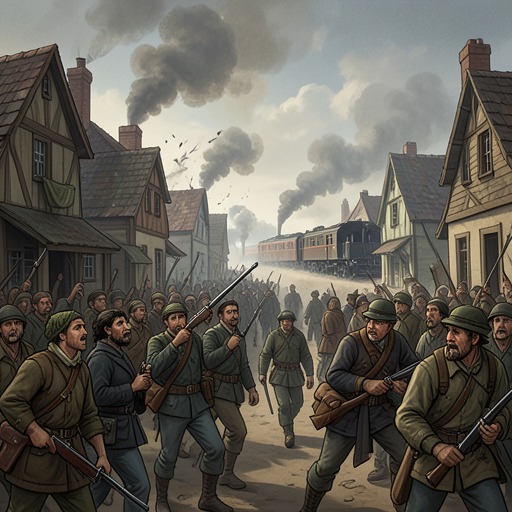
The fighting at Larson's Corners produces a rapid reversal in the surrounding military situation. Men leave Oldville with the expectation of driving the Federal troops away, but a later report announces that the Federal forces are in retreat. The celebration is immediately interrupted by cannon fire from the mountainside. Federal troops then enter the town, exhausted from hard fighting, and additional troops follow until the roads and green are crowded.
The retreat is not a single orderly movement but a developing stream of soldiers. Musketry continues without pause, cannon fire sounds intermittently, and troops who first enter Oldville move toward the mountain road as more Federal forces arrive. The battlefield thus reshapes the town's space: roads, public ground, and the route toward the plantations become military corridors. The narrative presents Larson's Corners less as an isolated field than as the origin point of a widening zone of movement and danger.
Local Defense and the Home Guard
The battle also activates local organization. Darcy Gilbert runs to meet Jack Ruthven and tells him that a fight is in progress. Jack immediately proposes calling out the Home Guard again, while Darcy explains that the stores and homesteads require protection and offers to summon the boys along the shore road. The exchange shows how Larson's Corners converts military news into a civilian duty: the local men must guard property and settlements when regular forces cannot guarantee their safety.
Jack's response is energetic but not reckless. He longs to participate in the fighting, yet he recognizes that the Home Guard has no useful role while Federal troops occupy the town in strength. If the local force opened fire, it would be annihilated. The guard therefore does not confuse courage with a futile attack. Its immediate purpose is protection rather than battlefield glory, and Jack's judgment preserves the distinction between defending the community and challenging an army it cannot defeat.
Consequences for the Plantations
The battle's direction soon makes the Ruthven properties an immediate concern. After the fighting shifts from the town to the mountainside and then toward the Ruthven plantations, Jack Ruthven tells Darcy Gilbert that they should go to St. John Ruthven's place to ensure that no damage is done. The move links Larson's Corners to the story's recurring struggle over plantations, property, and personal responsibility.
Darcy objects that St. John Ruthven should defend his own property because he has refused both military service and membership in the Home Guard. His complaint exposes a contrast within the plantation society surrounding the battlefield. St. John possesses a plantation but has neglected it, while Jack—an adopted member of the Ruthven household whose parentage remains uncertain—acts to protect homes and stores. The battlefield therefore tests social rank against practical worth: inherited position does not automatically produce courage or service.
Narrative Significance
Larson's Corners marks the point at which the wider war becomes impossible for the characters to treat as distant background. The earlier life of the Ruthven household is tied to land, family, inheritance, and the legacy of Colonel Martin Ruthven, who died at Gettysburg; at Larson's Corners, another battle sends the consequences of that national conflict across roads, town buildings, and plantations. Even the church is struck by cannon fire, while the stores and town buildings are spared direct attack, emphasizing that military violence is both indiscriminate in reach and uneven in result.
The location also clarifies the novel's moral geography. Guerrillas elsewhere are described as followers of whichever army offers opportunities for looting, whereas Jack Ruthven and the Home Guard define their role through protection. Against a war that displaces exhausted troops and threatens civilian property, Larson's Corners becomes a test of whether local authority will be exercised through predation, withdrawal, or responsible defense. Its lasting importance lies not in a final settlement at the battlefield itself, but in the chain of decisions it forces: mobilize the Home Guard, refrain from suicidal combat, and move toward the plantations before the retreating and advancing forces can bring greater destruction.